Federal health agents quietly turned part of the world’s busiest airport into a mini-quarantine zone, and most Americans have no idea what that really signals about risk, power, and freedom of movement.
Story Snapshot
- Mandatory Ebola screenings and 21-day monitoring now funnel certain travelers through Atlanta’s Hartsfield-Jackson International Airport.
- Centers for Disease Control and Prevention (CDC) calls this one “layer” in a broader containment plan, not a silver bullet.
- Critics question whether adding Atlanta meaningfully increases safety or just expands federal control and hassle.
- The deeper issue is how much liberty and cost Americans will trade for a marginal reduction in a very small risk.
Atlanta becomes a forced chokepoint for Ebola-era travel
Atlanta’s Hartsfield-Jackson International Airport did not volunteer for this; federal authorities designated it as one of the narrow funnels through which certain travelers must now pass if they want to come home.[2][4] Effective late on May 22, 2026, any United States citizen or permanent resident who has been in the Democratic Republic of the Congo, Uganda, or South Sudan within the past 21 days can no longer just land anywhere.[1][2][4] They get routed into Atlanta or Washington-Dulles for mandatory health screening.[1][2] That routing rule quietly converts itineraries into a public health instrument, turning airline tickets into tools of disease control rather than mere travel plans.[4]
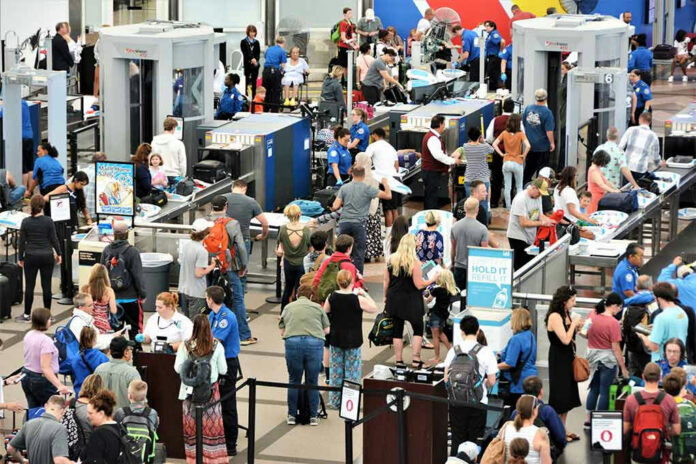
Once these travelers walk off the jet bridge in Atlanta, they do not simply stroll to baggage claim.[1] They are escorted or directed to a separate screening area where federal and health personnel go to work.[1][2] Officials take the basics: confirmation of recent travel in the three outbreak nations, a temperature check, and a standardized questionnaire about symptoms and exposures.[1][2] Anyone with concerning signs is pulled aside for further evaluation, and if needed, hospital transfer.[1] Those without symptoms still do not just melt back into the crowd; they are placed under 21-day post-arrival health monitoring coordinated with local and state health departments.[2][3]
CDC sells a layered strategy; effectiveness remains unproven
The Centers for Disease Control and Prevention insists these Atlanta screenings are not a magic shield but one “component” of a layered defense that also includes exit checks overseas, airline illness reporting, and follow-up monitoring after arrival.[2][3] That framing matters. Even the CDC acknowledges that airport thermometers alone will miss some cases, because Ebola’s incubation period means people can travel while still feeling fine.[2] The agency’s own announcement does not offer a quantitative model, detection-rate estimate, or clear evidence that adding Atlanta to the existing Washington-Dulles screening meaningfully changes overall risk.[2]
Public-health history shows that airport screening often functions as much as a visible reassurance as a precision instrument.[2] Temperature checkpoints, questionnaires, and roped‑off areas send a political message: the government is “doing something.”[2][3] The actual numbers tell a cooler story. The pool of potentially infected travelers is tiny relative to millions of annual passengers, which means even a well-run screening net mostly catches healthy people while any infected person who is presymptomatic can slip through.[2] From a common-sense conservative perspective, that raises a hard question: is the added bureaucracy justified without clear evidence of substantial incremental benefit?
Costs, burdens, and the conservative question about tradeoffs
Mandatory routing and enhanced screening impose very real burdens on a very small group of travelers. Citizens who happen to work, serve, or do mission or business trips in eastern and central Africa now face forced detours through specific airports, delays for screening lines, and weeks of follow-up calls or check‑ins.[1][4] Foreign visitors and some green card holders coming from the three affected countries are simply barred from entry for now, regardless of individual risk.[1][3] That blunt instrument approach may lower theoretical importation risk, but it does so by sweeping people into broad categories rather than judging their actual behavior or exposure.
From a limited‑government lens, the pattern will look familiar. A crisis overseas leads to federal rules at home that are easy to announce and hard to roll back. Each new “designated airport” becomes a precedent for using travel infrastructure to monitor and channel citizens.[4] The American instinct is to ask for proof before surrendering time, privacy, and freedom of movement. Yet the public record so far shows no Atlanta-linked Ebola case and no published analysis quantifying how much the second screening site improves early detection compared with Washington-Dulles alone.[1][2][3]
Reassuring the public versus preparing for the worst
Health officials keep repeating that the risk to the general American public remains very low, even as they expand these airport measures.[1][3] That tension is not accidental. Leaders worry that saying “low risk” without visible action invites accusations of complacency if a rare case does arrive. So they build these visible chokepoints: special routing, infrared thermometers, interview stations, and 21-day follow-up.[1][2] The result is a system designed as much to show toughness as to capture the handful of cases that might otherwise be missed.
"Mandatory Ebola screenings have officially expanded to Hartsfield-Jackson Atlanta International Airport for travelers arriving from the DRC, Uganda, and South Sudan. 🚨
Those who pass will still face 21 days of strict symptom monitoring by local health departments.
— Mazi okwuoma (@MaziEzike_Nedu) May 26, 2026
Thoughtful conservatives can accept serious threats like Ebola and still demand evidence that each new layer of federal control delivers results proportionate to its costs. Ebola is deadly and should be taken seriously. But public policy still must answer basic questions: How many cases will this likely catch? How many false alarms will it generate? What is the plan to unwind the restrictions once the outbreak ebbs?[2][3][4] Without those answers, Atlanta’s new screening zone risks becoming another permanent fixture of crisis‑era government that outlives the crisis itself.
Sources:
[1] Web – Ebola-related travel restrictions now include Atlanta’s Hartsfield …
[2] Web – Enhanced Ebola Airport Screening Expands to Atlanta – CDC
[3] Web – US names second airport for Ebola screening as cases in Congo …
[4] Web – Public Health Arrival Restrictions and Enhanced Ebola Screening