
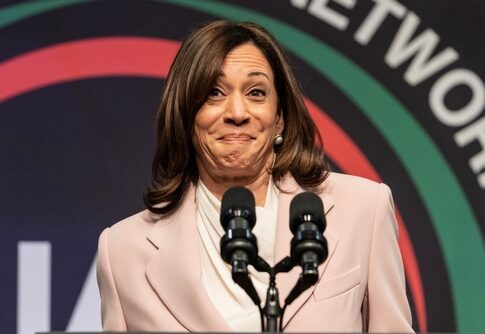
Democratic Party leaders say Kamala Harris “worked her behind off,” yet she won the 2024 nomination without facing a single primary opponent on the ballot.
Story Snapshot
- Kamala Harris won 99% of delegate votes in a virtual roll call, far above the nomination threshold.
- Harris was the only candidate to meet the ballot threshold; no rival campaign reached it.
- Delegates were not bound after Joe Biden withdrew, yet most lined up behind Harris within hours.
- Evidence of Harris’s personal delegate outreach remains thin in public records.
DNC Certifies a Near-Unanimous Virtual Roll Call
Democratic National Committee officials certified Kamala Harris as the party’s 2024 presidential nominee after a virtual roll call in early August. The tally showed 4,567 delegate votes for Harris, which equals 99 percent of participating delegates. That total cleared the party’s required majority with ease. Party leaders Jaime Harrison and Minyon Moore announced the result and closed any remaining process questions. The count gave Democrats a nominee with almost no visible internal split, at least on paper.
Party records show Harris was the only candidate who qualified for the virtual roll call ballot. The rules required at least 300 delegate signatures to appear. Other names surfaced but failed to reach that line. Harris alone met the mark after Biden’s withdrawal and endorsement. Major media described her as the sole competitive candidate to launch a real bid in that short window. That created a one-lane path to the nomination and a smooth tally for party leaders.
Rapid Endorsements After Biden’s Exit
Associated Press reporting stated Harris secured enough delegate commitments within about 24 hours of President Joe Biden exiting the race on July 21, 2024. By the evening of July 22, she was the presumptive nominee. State delegations moved fast to back her, and the endorsements spread across the map. Analysts later noted that every Democratic governor and almost every Democratic senator and representative backed her by July 24. That wave shut down any chance of a real contest.
Democratic Party rules add key context. Delegates were not legally bound after Biden stepped aside. They could choose anyone. Yet most still rallied to Harris right away. That fast shift shows how much power endorsements and party unity can have in a crunch. It also shows how the modern nomination process can pivot overnight when an incumbent drops out, and a clear heir gains momentum with establishment support.
“Worked Her Behind Off” Claim Meets Sparse Public Proof
Democratic National Committee voices argued Harris “worked her behind off” to secure support. But public records do not give many specifics on her personal outreach to delegates. Researchers and reporters have not produced logs of direct calls, meetings, or targeted persuasion in that critical 32-hour span. The process appears driven by top-down endorsements, rapid alignment from state leaders, and a rules path that favored one organized campaign in a short window.
Media tallies reported that Harris gained endorsements from nearly all state delegations, totaling well over 3,700 pledged delegates, before the roll call ended. That suggests strong coordination by the campaign and party allies. Yet it does not prove Harris herself did the heavy lifting one-on-one. The story remains clear on results but light on the personal grind behind them. That gap fuels debate about whether the nomination was earned by effort or handed by the machine.
No Primary Ballots, Only a Virtual Conclusion
Harris did not run in or win traditional primaries in 2024. The primary calendar ran from late January through early June. Biden collected delegates during that period, then left the race in July. The Democratic National Committee finished the nomination through a virtual roll call. That path is allowed under party rules, but it denies voters a direct Harris-versus-rival choice on state ballots. That fact shapes how many view the legitimacy of the process.
This moment fits a historical pattern. When an incumbent exits, parties often line up behind a successor without a long fight. Supporters call it unity and stability. Critics call it a coronation. In 2024, Democrats chose speed and certainty. Harris benefited from near-total elite backing and a rules structure that let delegates move fast. The certified numbers are not in dispute. The open question is how much of that sprint was personal hustle versus the party clearing the track.
What It Means for Voters Who Want Accountability
Conservative readers see a warning light here. A nominee won without primary tests, with near-total elite support, and with little public proof of personal outreach. That reduces voter input and raises concerns about party control. It also signals how fast a party can centralize power when it wants to shut the door on choices. The facts show Harris won big. The process shows why many Americans want reforms that give voters, not insiders, the real say.
Sources:
twitchy.com, ballotpedia.org, en.wikipedia.org, abcnews.com